Surveying of classified facilities and restricted areas
Surveying of classified facilities is one of the most demanding fields of modern cartography and measurement. These works are carried out in restricted access zones, such as military units, critical infrastructure facilities, or areas of strategic importance to the state. Due to the nature of these locations, the contractor is required to demonstrate not only the highest technical precision but, above all, an impeccable ethical stance and the possession of appropriate security clearances.
Our team has years of experience in supporting investments subject to rigorous information protection procedures. We understand that the surveying of classified facilities is a process where data security is just as important as measurement accuracy. Therefore, we employ proven documentation flow systems that guarantee no sensitive information falls into the wrong hands.
Surveying in military zones – security and precision
The surveying works we perform in military zones cover a wide range of activities, from topographic and height surveys to the inventory of specialized defense infrastructure. We operate in full coordination with security services and the command of individual units, allowing for the efficient conduct of measurements without disrupting the facility’s ongoing operations. Every employee assigned to such tasks has undergone appropriate verification.
Modern surveying in military zones requires the use of equipment that does not emit unwanted signals and is resistant to difficult terrain conditions. We utilize advanced measurement technologies that allow for the instant acquisition of data with minimal time spent in restricted zones. This approach significantly raises the operational security standard of the entire investment.
Critical infrastructure and nuclear power surveying
Specialized surveying of critical infrastructure concerns facilities of key importance to the state’s functioning, such as power plants, lng terminals, or transport hubs. A special place in our offer is occupied by support for the nuclear power sector, where accuracy standards and control procedures are the most restrictive in the world. Our developments form the base for engineers ensuring the stability and safety of these strategic structures.
As part of our critical infrastructure surveying service, we perform displacement and deformation monitoring, which is crucial for the early detection of technical threats. By combining knowledge in the field of engineering surveying with security procedures, we are a trustworthy partner for the largest enterprises in the energy and industrial sectors.
Special permits and security clearances in surveying
The foundation of our activities in this sector consists of special surveying permits that allow for the legal performance of work in restricted areas. We possess certificates and certified classified information protection systems, authorizing us to handle documentation labeled as “restricted” and “confidential.” Without such authorizations, no surveying company can be admitted to work on facilities of strategic importance.
By investing in special surveying permits, we ensure our specialists are up-to-date with state secret protection regulations. Regular training and internal audits ensure our office is fully prepared to handle the most sensitive public and military contracts. By choosing us, you choose professionalism confirmed by official state documents.
Classified information protection and measurement data confidentiality
In our office, classified information protection is not just a regulation, but a daily practice. Measurement data acquired in the field is processed in isolated it systems, with access restricted to a narrow group of authorized personnel. Upon completion of work, documentation is transferred to the client in a manner that prevents interception by third parties, in accordance with the highest security standards.
Effective classified information protection in surveying also includes the secure storage of survey files and the archiving of digital data. We understand the specific requirements set by state institutions and uniformed services; therefore, our procedures are fully compatible with the requirements of the act on the protection of classified information. We guarantee full discretion and loyalty at every stage of project implementation.
Surveying support for military units across poland
Thanks to a network of offices located in strategic cities such as Warsaw, Krakow, Poznan, and Wroclaw, we provide efficient surveying support throughout poland. Our mobility allows us to quickly reach any military unit or strategic facility, regardless of its location. Local branches in Rzeszow, Katowice, and Nowy Sacz further strengthen our operational capabilities in the south of the country.
The territorial reach of our company ensures that the surveying of classified facilities is carried out by teams that perfectly understand the specifics of a given region and local administrative requirements. We are ready to cooperate on large-scale national projects, offering consistent security standards and measurement quality in each of our branches.
Public tenders in the defense sector – meeting classified information protection requirements
Implementing projects for the military and investments of key importance to state security requires more than just technical competence from the contractor. A key condition for participating in tenders for defense projects is demonstrating the ability to protect information classified as “secret” or “top secret.” This requires the entrepreneur to establish a rigorous security system, at the heart of which lies the classified registry.
Classified registry as a separate and certified organizational unit
A classified registry is a specialized cell within the company structure responsible for the flow of classified documentation. According to the act on the protection of classified information, its establishment is mandatory for contractors processing materials with a high degree of secrecy. At geo company, we understand the specifics of a dispersed structure – regulations allow for the creation of more than one classified registry, which, with our 9 branches, allows for efficient management of tendering and the implementation of local projects while maintaining the highest security standards.
Industrial security clearance (śbp) and personnel clearances
To enter a strategic tender, a contractor must hold an industrial security clearance (śbp) issued by the internal security agency (abw) or the military counterintelligence service (skw). This document confirms that the company as a whole has the full capacity to protect state secrets. Equally important are security clearances for key personnel – engineers and surveyors. This process usually takes several months, so at geo company, we ensure our specialists hold valid clearances well in advance, enabling us to immediately commence contract implementation.
Security officer and information security supervision
A key figure in the protection system is the classified information security officer. This is a person holding a security clearance issued by the services (abw/skw) after an extended screening procedure. The officer supervises the so-called security division, being responsible for physical, personnel, and it security. Their role is a guarantee for the contracting authority (e.g., the ministry of national defense) that every piece of information, from maps to 3d models, is protected against unauthorized disclosure.
Technical infrastructure: protective zones and accredited it systems
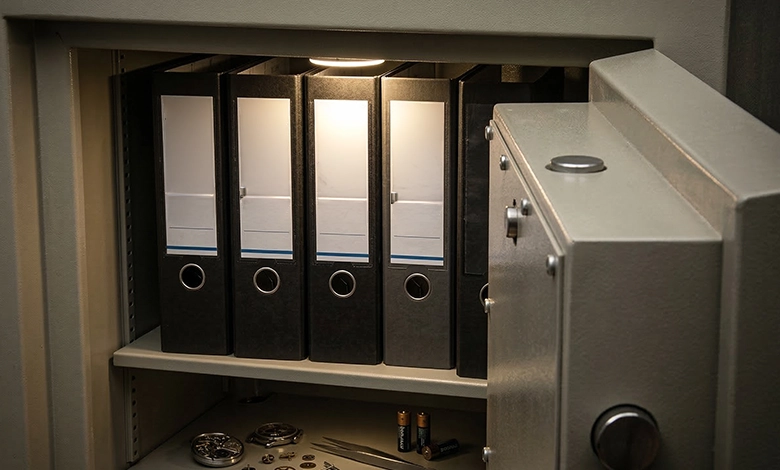
The location and equipment of the classified registry must meet strict technical norms. Premises must be separate, equipped with access control systems, monitoring, and certified reinforced cabinets and safes (consistent with the document secrecy level). In the case of digital surveying, a critical element is the accreditation of it systems. All computers and servers used for processing classified data must have certified software and security measures consistent with national standards, and often also nato or eu norms.
Strict document management and material destruction procedures
Every classified document, from the moment it enters the registry, is subject to strict accounting. Registration, assignment to the responsible person, and flow control are daily routines in working with classified information. Upon project completion or the expiration of the need for storage, documents must be destroyed in a manner that prevents their recovery, using specialized shredders of the appropriate secrecy class. Such procedures eliminate the risk of data leakage at every stage of the project lifecycle.